THE MURPHYS VS. MOLLY

I made this flier. I was proud of it.
I think a lot of white people in the United States are aspirationally Irish—especially when it comes to their media consumption. It’s part of the popular myth of the Irish in America: Civil War heroes who consistently prove their willingness to get down and dirty for the common man. I mean, who among us hasn’t watched The Departed and thought, [SPOILER] “I bet I could’ve saved Martin Sheen from being thrown off that building.
Obviously, it’s more complicated than that. I’m told there’s a fair amount of racism involved. But then, I’m not Irish. I’m not even Irish-American. I’m just American. Specifically, one thoroughly Californianized descendant of Ashkenazi Hungarian, Welsh, and maybe some French(?) people. But my dad was born on St. Patrick’s day, so he always lays a small (only semi-serious) colonial-cultural claim to Irish identity—at least by eating (yes, seriously) corned beef and cabbage as his self-designated birthday dinner every year. As for me, I took an Irish literature class way back in college, so I’ve at least read part of Ulysses, and I came up listening to two American “Celtic punk” bands that pay tribute to—or at least capitalize on—that myth: Boston’s Dropkick Murphys, and Los Angeles’ Flogging Molly.
Yuk it up, nerds. I love this shit. In high school, I blasted both bands to the brink of tinnitus, saw both live twice, and accumulated an intimidating collection of bootleg mp3s. Each band released one of its best albums—The Meanest of Times for the Murphs in 2007, and Float for Floggs McGoggs in 2008—during incredibly formative listening years for me. I was just starting to wonder if there was life in punk beyond the bubblegum pummel of Ramonescore throwbacks and first-gen Fat Wreck wannabes. Neither of these bands was new when I found them, but they were new to me—and I marched with military efficiency through each band’s entire discography to date. Yeah, I fell off with both eventually—the pretensions of college radio have a tendency to serve as a poison to good taste, if you’re not careful—but never completely, and I never denied their names like Peter did Jesus.
There’s no unique local loyalty here, either—I’m not from Boston, and I’m not from L.A. I’ve got friends and family in both cities, but I live in the East San Francisco Bay Area. Frankly, I’m less concerned about getting this whole upcoming debate “right” than I am about rising BART fees and the policies of the Contra Costa County District Attorney’s office.
In other words, who better than me, Roddie Snock, your old pal, to tell you which of these bands’ live album-with-accompanying-DVD’s is more worth your St. Patrick’s Day listening and/or viewing hours? Is it Dropkick Murphys’ Live on Lansdowne? Or Flogging Molly’s Live at the Greek Theatre? Ideally, of course, you’d check out both—because they’re both good, for different-but-similar reasons. But I’m getting ahead of myself. Let’s take a look at the combatants.
But first—the rules of this article’s accompanying drinking game!

If you’re playing it right, you’re already buzzed!
The Combatants
DROPKICK MURPHYS

ceedub13, CC BY 2.0 <https://creativecommons.org/licenses/by/2.0>, via Wikimedia Commons
| HOMETOWN | Boston, Massachusetts |
| FIRST ALBUM | Do Or Die (1998) |
| CURRENT LINEUP | Ken Casey (vocals, bass) Matt Kelly (drums)Al Barr (vocals) James Lynch (guitar) Tim Brennan (guitar, accordion, mandolin, tin whistle, banjo) Jeff DaRosa (tenor banjo) |
| MOST RECENT | Okemah Rising (2023) |
| HEAVY HITTERS | “Shipping Up To Boston”; “The State of Massachusetts”; “Barroom Hero” |
| SPOTIFY LISTENERS* | 2.95 million |
*Not that it matters.
Dropkick Murphys is a five-to-six-piece celtic punk-turned-arena rock (sorry, it’s true) band. I saw them in Oakland on November 6, 2009—my first concert (drink). I saw them again two years later at the Warfield (drink). Their live show is boozy, bruising, bombastic, and balls-to-the-wall—an amped-up, rattle-the-ceiling rager with a guaranteed mosh pit full of 45 year-olds going way too hard (drink). It’s a lot of fun, if you know when to duck. But, what else would you expect from the band that went platinum for “Shipping Up To Boston?”
These days, the Murphys have only one original member left—bassist and vocalist Ken Casey—but they began as a four-piece punk band from Qunicy in 1996. Guitar, bass, drums, vocals. They played party-punk (drink) in the American Oi and hardcore traditions, and mixed it with such sincere “I-love-you-bro, let’s get fucked up and reminisce about local union membership rates” (drink) theming that the punk world had to feel the shockwaves from coast to coast. Nobody played bagpipes.
After releasing Do Or Die in 1998, an incredible debut album featuring singer Mike McColgan, the band hit a snag—which was, Mike wanted to be a firefighter, like his uncle. He and the band split amicably, and Al Barr joined the Murphys for 1999’s The Gang’s All Here, along with nearly every album since then. Barr was a constant member until 2022, when he went on hiatus to take care of his mom—proving that this band has simply terrible luck when it comes to losing lead singers to actual good causes.
As far as I know, the Murphys were one of the first “big” punk bands in the 90s and 2000s to feature bagpipes—and they’ve had two different guys fill the role: Robbie Mederios, aka Spicy McHaggis, and Joshua “Scruffy” Wallace. As a side note, that is some fucking dynamite luck—finding not one bagpiper (pipist?) who can keep up with a punk band, but two (drink). Some of the band’s best songs admittedly do feature them ‘pipes. See “Kiss Me, I’m Shitfaced,” if only for the anthemic dick-joke energy that hits just right at the end of their sets. But between 2005-2007, when “Shipping Up To Boston” achieved apotheosis, partly for its inclusion in The Departed (In the title sequence of a movie about Boston—very clever, Marty), and about 2011, when the band released Going Out in Style, their sound got progressively more…well, for lack of a better term, bagpipe-y. Tin Whistle-y. That was about where I fell off.
Following several more albums I admittedly skipped, and Barr’s departure, the band released two albums of songs arranged for unused Woody Guthrie lyrics—a privilege of a project the Guthrie estate grants a lucky band every once in a while. It was some of the best shit they’d released in years (drink). Pretty sure nobody played bagpipes on the Murphys’ Guthrie albums.
In the interest of full disclosure, here’s a quick bias alert: Admittedly, at times I’ve (possibly unfairly) written off the Murphys’ appeal. It’s no secret they’ve had issues with the wrong kind of skinheads at their shows, in spite of how consistently they’ve expressed (for the most part) a traditional punk message of inclusion and blue-collar liberal politics. And yet, they’ve got at least one song on their first live album—”John Law”—praising a “fuckin’ good shit” cop that hasn’t aged…great, to say the least. Then there’s the argument that they gloss over the uglier parts of Irish-American history in favor of a guzzle-able whiskey-punk narrative (drink). If anything in their recent output has proved me wrong, it was the Guthrie albums. They’re clearly capable of displaying versatility with age.
There’s a reason they’re favored to win the match today—if you want to bet based on numbers alone, they’ve got over twice as many listeners on Spotify as Flogging Molly, and their raucous-by-design formula makes them a perfect contender under holiday conditions such as these. They’ve got home court advantage in a profoundly Irish-American city, they’re precision-rehearsed after six nights of shows, and they’re ready to demolish everything. Frankly, it’s their fight to lose.
FLOGGING MOLLY

Stefan Bollmann
| HOMETOWN | Los Angeles, California |
| FIRST ALBUM | Swagger (2000) |
| CURRENT LINEUP | Dave King (vocals, guitar)Bridget Regan (violin, tin whistle)Dennis Casey (guitar, vocals)Matt Hensley (accordion, concertina)Nathen Maxwell (bass, vocals)Spencer Swain (mandolin, banjo, guitar, vocals)Mike Alonso (drums, percussion) |
| MOST RECENT | Anthem (2022) |
| HEAVY HITTERS | “Drunken Lullabies,” “Float,” “Black Friday Rule” |
| SPOTIFY LISTENERS* | 1.2 million |
*Not that it matters.
I have to admit to some experiential bias here: Flogging Molly is the band I’ve seen live more than any other band (drink). I think I’m up to eight times, at least three in high school alone.
Incidentally—are you keeping track of your drinks? Because I’m getting tired of helping. You’re on your own from here on out.
I could easily describe this band as “the real fucking deal” musically—especially on stage. For all their lineup changes over the years, they’ve mostly maintained a seven-piece ensemble of skate-punks and folk-rock savants to channel traditional Irish music more explicitly (perhaps) than the Murphys ever have. Led by Dave King, a former hair metal vocalist and a songwriter’s songwriter—as well as an actual Irish guy—since 1994 they’ve been perfecting the sound of a true hometown pub band, expertly adapting it and plugging it in for everything from wistful vignettes featuring Lucinda Williams to “Drunken Lullabies’” prominent inclusion in a Tony Hawk video game soundtrack. I’ve seen veteran deadheads dance their asses off to Flogging Molly at the Hardly Strictly Bluegrass festival, and I’ve seen people pull each other off the ground in Flogging Molly mosh pits, beaming, asking “You OK, bud? Great, get back in there!”
Flogging Molly has released nine studio albums since 1998—an impressive frequency, considering they’re on the record for treating recording sessions like mini family reunions, gratuitous bottle-cracking included. King’s claimed facetiously that the band actually lost money on Float because they drank so much of the Irish recording studio’s in-house whiskey. Regardless, they’re certainly one of the groups that did great work for SideOneDummy Records—arguably paving the way for that label to sign a whole spectrum of up-and-coming punk rock prizefighters ranging from Gogol Bordello to Jeff Rosenstock. Flogging Molly’s many, many label jumps over the years culminated in 2022’s Steve Albini-produced Anthem—which was recorded quickly, passionately, almost sloppily (in the best way), at Electric Audio. The band was no stranger to Albini’s famously hands-off production approach, having worked with him on two of their best and hit-producing albums: Swagger (2000) and Drunken Lullabies (2002).
Sonically, they’ve only rarely taken their foot off the gas—they must know that their fans largely go to Flogging Molly shows for their routine prescription of a mosh-and-a-wee-jig dance party. But every album, despite the occasionally monochromatic veneer (i.e., it’s all heavily rooted in Irish folk music, and arguably less traditionally punk-sounding than the Murphys), has its fair smattering of slower, emotive songs—even ballads like “Whistles the Wind,” a desperate “Please Get Better” love letter to a dear, depressed friend (or possibly oneself), which literally makes me cry.1
Yet, for all their success on the American punk circuit (including Warped Tour) and internationally, and in spite of their ability to maintain a literal yearly ocean cruise full of bands they’re friends with (not punk at all, but hey, you should love seeing the bands you love succeed), they’re nowhere near the Murphys’ level of prominence in the American popular concept of Celtic punk. To put it bluntly, even if Flogging Molly has shown more sonic and lyrical versatility over the years (admittedly not a given), and even if they can still arguably boast more “punk clout,” (again, not necessarily a given) that doesn’t change the fact that, for many people, Dropkick Murphys is the Celtic punk band that matters—possibly based on TV placements and sports anthems alone. Some might say it’s the only one that exists.
In that sense, it’s an uphill battle for Flogging Molly today. We’ll have to see if their superior numbers and diverse instrumental lineup give them a fighting chance at matching Al Barr’s power vocal stage presence, and the Murphys’ more explicitly hardcore influences. Molly’s not known to rely on outright stage antics, as we’ll likely see the Murphys bust out, and they’re similarly less likely to incorporate high-profile guest appearances—again, something the Murphys excel at.
But it’s clear that these bands are similar in many ways. So, we need a way to fairly and objectively compare them. That’s where the Pogues come in.
Standard of Review: The Pogues’ Streams Of Whiskey

Public Domain
Boston versus Los Angeles. It would be easy to write each band’s sound off as a cross-coastal parallel to the other—Flogging Molly’s invocation of SoCal skate-and-hardcore versus the Murphys’ Northeast oi-and-hardcore origins. After all, the Murphys’ debut predates Flogging Molly’s by two years. I’ll get into the reasons I can’t condone this interpretation later—they involve everything from lyrical styles to punk traditionalism.
No matter how you slice it though, both bands certainly owe a heavy debt to the Pogues—arguably the first Celtic punk band that mattered. For the purposes of this fight, just know that they were formed in 1982 by the still-tragically underappreciated Shane MacGowan, a lyricist first and foremost and a poetic soul, at least in the specific unromantic way that leads brilliant storytellers to destroy themselves. This was long before either Dropkick Murphys or Flogging Molly even existed in concept, long before they would glorify the boozing that beleaguered one of their obvious heroes. Still, understand that, like both their descendants, the Pogues were known for an absolutely incredible live show. And even more so than the punk-fusion protegés, the Pogues demonstrated a relentless instrumental commitment to the Irish musical tradition—because who says acoustic shit isn’t punk? In that sense, they’re the profoundly perfect standard unit of measurement to weigh the relative merits of Dropkick Murphys’ and Flogging Molly’s live albums.
For the duration of this fight, as a platinum-standard reference for live Celtic punk, I’ll be referring at various points to the Pogues’ Streams of Whiskey: Live In Leysin, Switzerland 1991. It’s a holy mess of a live record, but in that specific, classic way that makes it punk as fuck. It’ll do fine.
You know what? Let’s throw a little gas on the fire, shall we?
- Shane MacGowan.
- Shane MacGowan.
- Shane MacGowan.
Now, “Let’s get ready to R U M B L E !”2

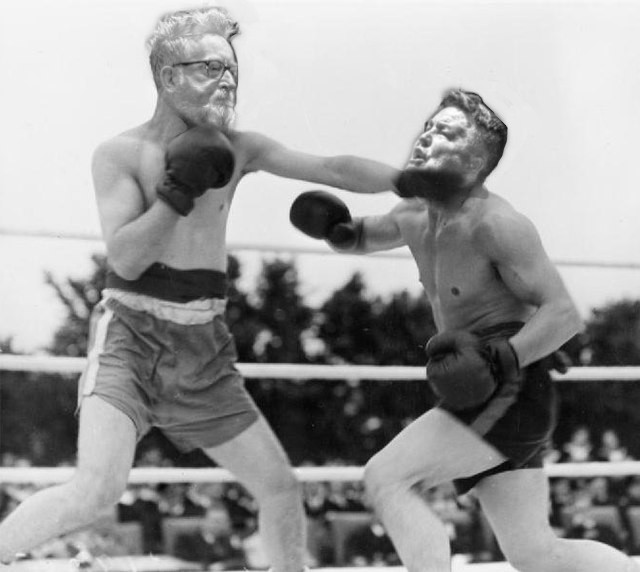
Flogging Molly’s Dave King shows Dropkick Murphys’ Ken Casey how a real Irishman throws a punch. THIS “REALLY” HAPPENED.
Round 1: Setlists
This round covers the most obvious, and arguably most important, aspect of these or any concert: “What songs are they actually playing?” In Streams of Whiskey: Live In Leysin, Switzerland 1991, the Pogues played seemingly all of their best songs. And if they didn’t, then it’s noteworthy that at least the casual-listener ones are all there— “If I Should Fall From Grace With God,” “Sally MacLennane,” “Dirty Old Town,” “The Sickbed of Cuchulainn,” “Boys from the County Hell,” “Streams of Whiskey,” and “Sunnyside of the Street.” Yeah, “Fairytale of New York” is missing—but come on, man—that’s a Christmas song. Bottom line, it’s a slew of hits from throughout the band’s history—which, importantly, was at that point only about nine years.
By 2008-2009, when the Murphys recorded Lansdowne and Molly recorded Greek Theatre, both bands had been around for over a decade: thirteen years for the Murphys, and fourteen for Flogging Molly. While that’s not much more time than the Pogues had been around in ‘91, it’s safe to say that these second-or-third-generation Celtic-punk bands each easily had, respectively, dozens of phenomenal songs that they simply didn’t have time to play on these live albums.
With that said, the setlist cuts have to happen somewhere—and whereas the Murphys go for their gold-and-platinum-sellers (along with a lengthier “Deluxe Edition” that features some slightly relatively more memorable album B-sides), Molly takes a more nuanced approach, and they play not only the classics and bangers, but a selection of deep cuts that cut deep. Each strategy has mixed success—you’ll see what I mean.
Dropkick Murphys
With no initial address to the crowd, the Murphys bust outta the gate immediately here, dick-kicking their way into the House of Blues with a strong starter of “Famous for Nothing” from The Meanest of Times, waxing nostalgic on growing up a Quincy punk. They transition quickly into two more Meanest songs, “The State of Massachusetts” and “Johnny, I Hardly Knew Ya”—songs that aggressively invoke folk instrumentals and storytelling—before crashing into “Time to Go,” a Boston Bruins tribute from their 2003 album Blackout. It’s a quick trip to detox after that, with “Sunshine Highway” from The Warrior’s Code (2005), and then—finally—they thrash around to one of their best songs (and honestly, my favorite), “(F)lannigan’s Ball,” a brawl-starting bonanza that featured the Dubliners’ Ronnie Drew on its studio version. Barr takes over Drew’s parts here, diabolically ripping the shit out of lyrics like “Christopher swore he’d go no further ‘til he had revenge,” and “I soon replied to that fine introduction, and gave him a terrible kick in the spleen.” It’s enough to make you wanna sock the guy sitting next to you on the fucking bus—and, moreso, anyone next to you at the fucking Murphys show. Notably (though you can’t tell on the recording), the band brings out a team of girls from the Forbes Academy of Irish Dance, a Quincy institution, as visual accompaniment for “Johnny.” More on that later, when I discuss the quality of the albums’ accompanying DVDs.
It’s a few slightly (not slightly) more touchy-feely songs after that: a tribute to the deceased called “God Willing” that manages to triumphantly capture both grief and bitterness, and turn it into a promise to remember them, and keep the fucking faith against all odds. Nobody’s ever truly forgotten, or so it seems; then there’s “Caught in a Jar,” about “A time in every man’s life when decisions have to be made.” It’s a self-improvement jam that asks frankly important questions: Are you gonna “labor” and “toil, or just plain piss your days away[?]” It’s one of the only Do or Die songs in the entire set, and there’s the question (whether warranted or not) of whether Barr delivers this one better than McColgan did. For my part, the answer’s an uncomfortable “Al’s great, but not so much on this specific song.” But the crowd goes nuts for it, so it’s clearly worth something, and I’m probably wrong. Next, we get “Bastards on Parade,” also from Blackout, which turns from an almost cute jingle about being a contrite bad guy into one of the bigassest pit catalysts on the whole live album. It’s never been my favorite Murphys song, but it sounds great here.
After that, “10 Years of Service” from The Gang’s All Here—one of the all-time best Dropkick Murphys songs from their best(?) “punk” album, originally produced by Lars Frederiksen of the Bay Area’s own Rancid.3 But you only get to hear it if you bought the “Deluxe” version of Live on Lansdowne. Which is kinda shitty of them. By this point, it’s become apparent that the first two or three Murphys albums (’98-’01) are getting seriously slighted in this set.
It’s back to 2005 after that, with “Captain Kelly’s Kitchen”—a pure storytelling song with a folk chorus of “Me toora loora la, me toora loora laddie,”—clearly one of their most dance-able moments in the whole set, as well as among the most explicit they’ve ever been with the whole “Celtic” thing. The Forbes dancers come back, and the way everyone in the band seems to get a lyric here and there is overwhelmingly fun and refreshing, considering how much of the set is vocally dominated by Casey and Barr.
“Shattered,” also from The Meanest of Times, provides a welcome hardcore reprieve from the “toora loora la’s,” with some of the band’s more explicitly political (and probably better) lyrics forming perfect shoutalong catharsis after (presumably) some tears got to flowin’ during “God Willing” and “Bastards.”
Alright, we’re halfway through the set. I’m exhausted already. Time to back away from the pit and catch my breath—Christ, I’m gettin’ old. The dad-punks around me apparently feel similarly. Shouldn’t have ordered that double from the well when I got here.
Casey dedicates “Fields of Athenry,” a classic ballad of the potato famine (yes,that one) to fans from overseas who “got on a plane” to see the show. Never been my favorite of theirs—frankly, the No Use For A Name version kinda sounds better. Which is, to say the least, kind of embarrassing for Dropkick, considering No Use was from fucking Sunnyvale, California (and therefore are also the closest thing I have to a “hometown hero” band—but that’s another story).
I’m gonna go ahead and gloss over the rest of the individual tracks in their specific order—I’ve long since passed the binge-drinking tipping point. All I want to say is that it’s a lot more of the songs that did serious sales numbers on iTunes back in the day. Also, “Citizen C.I.A.” is the best song of the entire set. No other comments on that one.4 It’s just the best. Check it out. And, finally, I just want to say that I don’t really care for “Tessie.” Sorry, Red Sox nation. “Sweet Caroline” is kind of shitty too. No other explanation.
If we’re being brutal here, probably no other song in either of these bands’ respective sets goes anywhere near as hard as “Shipping Up To Boston,” which the Murphys wield like a nuclear bomb at the finale of an already-monstrous show.
And yet, there’s no denying the absence of some older, absolutely critical Murphys songs: worst of all, “Barroom Hero,” one of the best songs from Do Or Die and the song that first introduced them to the punk world, is nowhere to be found. We don’t even get “Boys on the Docks.”5 We don’t get to hear them do “Skinhead on the MBTA” for the outro, but we know they played it, and we don’t get any of their wildly boneheaded, unfairly fun classic rock covers. I’ve seen them take on Bon Scott AC/DC, man. Barr kills it.
Flogging Molly
OK, in the interest of saving some time here (because I can’t keep drinking like this to my own article. It’s not going well, I’m not gonna lie. I did not think this through sufficiently), I’m just going to toss a quick colorful chart in here and let it do the talking for a minute while I lie down on the bathroom floor—I’m starting to get the spins.


OK—I’m back. You might want to let the bathroom air out for a few minutes. I lit a candle.
Look, this is just a spectacular setlist from a band with a bottomless supply of songs perfect for the Greek Theater environment. Classics, hits, extremely deep cuts, and welcome surprises are all here.
Round 2: Energy
Dropkick Murphys
I mean, holy shit does this night sound raucous. From the crowd’s opening chorus of “Let’s Go Murphys” to the Pangaea-splitting finale of “Shipping Up To Boston,” the energy level in the room doesn’t dip for a second. Even during “Kiss Me, I’m Shitfaced,” the slowest song of the night (well, part of it’s slow, at least), we’ve still got a venue’s worth of women stumbling wasted about onstage with the band, word-slur-singing every word in exactly the worst possible keys simultaneously. “(F)lannigan’s Ball” and “Citizen C.I.A.” are probably the night’s most mosh-worthy moments, but trying to narrow that plethora down to a manageable list of mosh-worthy moments would probably be impossible—might just reveal which of the Murphys’ most popular songs are your favorites. It did for me.
Flogging Molly
This set starts differently from the Murphys’ “Boston Massacre” approach—the cannonball-into-the-crowd of “God Willing.” Flogging Molly begins with King alone onstage, strumming “The Likes of You Again” from their debut Swagger, one of their Albini records and a great example of King’s songwriting muscle. As he sings about his dearly departed father, violin and mandolin and accordion slowly creep their way into the arrangement, piece-by-piece, until King issues nearly a challenge to the crowd: “You know what? I know that bastard’s watching over me.” Only then does the whole thing explode into pure punk bliss.
At times it’s more subdued, admittedly. But it’s not necessarily the band’s fault that their slower songs hit so close to home. I mean, it is their “fault,” in a sense, but it’s calculated, and it feels good. So, this one’s up to your interpretation, I guess—if you think an overall energy dip is a bad thing at a punk show for any reason, then hey, you’ve got your answer as to this round’s winner. You’d have a point, admittedly. But I’m more inclined to say that a great live set, like a great DJ set, has ups and downs, paradigm shifts, abrupt stops, and smooth restarts at various points. And if the crowd’s energy suffers at all from King’s tendency to introduce these songs with their jolly origin stories (it takes valuable recording time to do this, you know—he knows that too), it’s not because the crowd dislikes these stories. The end result is audio intimacy. I’m actively listening to him as if I was there. It’s not always the highest-energy, but there’s still plenty of moshable mayhem to offset (god forbid) those moments of actually feeling feelings. The band deftly rips and cuddles alternately.
Round 3: Beauty
Dropkick Murphys
This set lacks something in the way of dynamism. It’s a fact: The Murphys’ swooning ballads don’t hit as hard as their…well, harder-hitting songs. It’s not to say the sincerity’s absent—but even among the category of Dropkick Murphys songs that are about their dead or otherwise departed friends, the faster songs are just better. Take, for example, “God Willing” as compared to “Forever.” The former takes grief and transforms it into a triumphant shout-along hymn. The latter plods along and careens from side to side in pretty substantially stagnant fashion. “Shitfaced,” their best ballad, is a great composition, but would you call it “beautiful?” Maybe. But you’d be a smartass. I’ve never cried to a Dropkick Murphys song like I have to multiple Flogging Molly classics.
And then, there’s that bit right before they play “Tessie,” where Casey sort of expresses the view that he’s fine with even Yankees fans visiting town, as long as they’re…good cops? And as long as baseball season isn’t approaching, of course. Maybe this is too fine a point to put on it, but I just can’t get behind that. It’s just not punk at all—and this is coming from me. And it highlights a common, largely valid criticism of Dropkick’s very deliberate “working class” branding: Which working class are you talking about? Because last I checked, it’s more than just the Irish, and these supposedly “fuckin’ good shit” cops have done a lot more harm—or at least been complicit in more harm—than good. Two songs later, they play “Worker’s Song,” and I’m left seriously doubting its profundity. And all of that’s before they bring out “Special Guests” The Mighty Mighty Bosstones, complete with vocals by the Duke of the Antivax Moron-Punks, Dickie Barrett, to bust out “Shipping Up.” Barrett hadn’t quite devolved to that point yet when Lansdowne was recorded—but it makes that party-hungry audience look slightly different—if not physically, then ideologically—as they flash in the multicolored venue lights.
I’m not accusing the Murphys or their fans of being fascist apologists—not so bluntly, at least. Because honestly, that whole debate is tangential to the one actually presented here: Is this setlist better than Flogging Molly’s?
Flogging Molly
Here’s the thing—many Flogging Molly songs, including more than a few from this setlist and beyond, really are beautiful. With more maturity and nuance, especially lyrically, than the Murphys have ever—literally ever—come close to achieving. From the first big tempo kickup in “The Likes of You Again,” after King declares of his departed father, “I know that bastard’s watching over me,” to the contrasting, earnestly simple tribute to making it through another dark, depressing day alive in “Float.” Any way you slice it, King bares his soul in a profoundly humbling way.
The songs chosen for a mini-acoustic set, “Us of Lesser Gods” and “The Son Never Shines on Closed Doors,” glow here. They’re a high point in the whole set, because they were meant to be performed this way, seemingly. This isn’t subgenre filler fusion tribute-rock that simply uses Ireland as a springboard—it’s genuinely ass-kicking Celtic-American folk. It purports, utterly sincerely, to be nothing else. The Pogues oughta be proud.
And of course, the way “If I Ever Leave This World Alive” makes me laugh, utterly joyously, through my own existential death anxiety, is nothing but fucking magical. Whether or not Flogging Molly has more “heart” or “passion” than Dropkick Murphys is probably a difficult-to-impossible question to answer. But I think it’s basically indisputable that, in an almost literary sense, Flogging Molly’s poetic substance atleast makes them the “smarter,” or more “articulate” band. As a direct result, they make me feel it, relate to it, to such a degree that it’s almost psychic. And I’m not even Irish, and I’m not from L.A. But I feel like part of the family.
Round 4: The DVDs
Dropkick Murphys
The Murphys lunge when they play their instruments. Never more apparent than during “(F)lannigan’s Ball,” which, needing no fucking introduction, gets none, beyond the band all thrashing in metronome-tight unison. They’re all dressed in business-casual black, with the exception of Barr, who’s just perpetually in a tight t-shirt.
It’s a lot of flashing rainbow lights. The shots of the whole theater are epic in scope—nothing beats aerial footage of a thriving mosh pit. But it sucks that watching the actual musicians is sometimes less exciting, because their arena-sized stage presence is dwarfed by too-quick camera cuts, suffocating close-ups, and a nuclear fuckton of neon-fluorescent wattage. Look—if every light on the stage is red, then when you watch the movie, everyone on the stage is going to blend in. Except Al Barr, of course—he’s down in the front giving high-fives to seemingly everyone in the crowd. Man, you gotta love Al Barr. He’s a better singer than Casey, without any of the complicated cop rhetoric.
Incidentally, Scruffy looks utterly not stoked to be onstage with the band the entire time. I’ve heard that his favorite band is Slayer(!) so I suspect this Murphys gig is just about the best regular work you can get playing bagpipes. Though, I’d love to hear a Dropkick metal album. Might suck, but it’d suck audaciously. It’d suck boldly.
You could call this relative visual chaos an attempt to recreate the experience of actually being there—but then why give us the aerial views at all? The Beastie Boys did that “make them feel like they’re in the crowd and tripping” on Awesome…I Fucking Shot That! when they gave handheld camcorders to members of their Garden audience—and it was great. We can safely assume that there was at least some consideration made in the process of staging Live on Lansdowne that this needed to be more than a “like I was actually there” experience—someone wanted this thing to be cinematic, like all truly spectacular “concert films” are.
But that’s the thing—a great concert film is more than aerial views and high-fives. It’s about the spirit of the thing. The Murphys clearly understand this; they bring out the Forbes dancers and the Bosstones, shout out fans from all over the world, and I fucking like it when Al Barr takes a minute to namedrop every(-ish) member of their road crew and thank them. Man, Al Barr’s great. But beyond the fact that its context is “hometown show on St. Patrick’s Day,” the movie doesn’t sparkle narratively. We don’t really get any pregame interviews with the band and crew, so there’s no elaboration on the friends they briefly name between songs. It’s all about the greatest hits, and not always to its benefit.
Unfortunately, as a movie, it’s down-the-middle and safe. No matter how solid the setlist and energy, this live album-with-DVD would’ve worked equally well—if not better, honestly—without its accompanying DVD. Personally, I’d have preferred a double live album with a longer setlist of appropriately local deep cuts. Maybe they could’ve even brought out Mike McColgan to do his versions of his Murphys songs, which are mostly missing.
The credits reel of them hanging out with their drunk friends is fun, though.
Flogging Molly
It’s truly and sincerely not a knock on the Murphys’ actual, technical ability when I say that Flogging Molly looks less “calculated” as a group. The Murphys’ unofficial “punk funeral” uniforms have the unfortunate side effect of blurring the meaningful differences between the bandmates who aren’t Barr or Casey—so it’s fantastic to notice that no two members of Flogging Molly came dressed the same to this show. The band has seen a lot of faces come and go in the last thirty years, but they still manage to convey the feeling of old friendships between wandering misfits who were lucky enough to find each other to weather the storm. They’re not a monochromatic commando-punk strike force. Instead of wearing arguably watered-down uniforms (sorry) to invoke Johnny Cash’s image, Flogging Molly instead goes on record to dedicate a song to Johnny: “The Lightning Storm,” which King explains is “a song about being pissed off.”
Flogging Molly’s Greek Theatre stage lighting tends to be less oppressive than the Lansdowne DVD’s—frankly, makes it much easier to actually enjoy the plethora of close-ups of the bandmates all going absolutely ham on their instruments. You have never seen a guy shred an accordion like this. Trust me. The fact that I can see the sweat flinging off their foreheads, staining the brims of their hipster-punk porkpie hats, is exactly the reason I watch concert movies. Well, not necessarily that specific reason—my point’s more that the details matter.
Round 5: Sudden Death Overtime
It’s a close one, but I gotta give the fight to Flogging Molly. The Murphys doubtless pack more firepower, more unrelenting force. But there’s more to Irish, and Irish-American identity, than firepower and force alone. And the Murphys’ grasps at classic-rock bravado and their own high-point-of-power legacy leave their album lacking in the Feels Department.
Flogging Molly’s best songs within the Celtic punk “sound” hit as hard as Dropkick’s best songs, with “Shipping Up To Boston” as really the only exception. King’s lyrics are almost universally more mature, and they lend themselves well to the band’s “come over here and let us tell you a few old stories” approach. You know this one—and the fact that it’s not playing at upwards of 140 beats per minute doesn’t bother you one bit. These are your friends. “And,” as King says repeatedly, “by all means, join in.”
Or maybe the West Coast just does this whole subgenre better. I don’t know. Fight me, Boston.
Man, I am drunk.
- “It breaks my heart to see you this way/the beauty in life, where’s it gone?/And somebody told me you were doin’ OK/Somehow I guess they were wrong” ↩︎
- I am aware that Michael Buffer has this phrase trademarked. Apparently it’s earned him over $400 million. So, to Mr. Buffer and his Estate: Please don’t sue me. Just leave me alone. I’m just one writer, for fuck’s sake. I am definitely not making money on this shit. ↩︎
- I once met Lars in a grocery store parking lot. Lovely, friendly dude—but I forgot to ask him about The Gang’s All Here. ↩︎
- Once in a high school English class, I was required to bring in a poem that I found meaningful, and read it for the class. I chose “Citizen C.I.A.” because it was political, pissed-off, and heavily indebted to classic Boston Hardcore. What, was I supposed to choose “T.V. Party?” ↩︎
- Go listen to these songs. ↩︎
 SNOT ROCK BOT RADIO