An Expedition Through the Cultural Swamp in Search of Happily Ever After

- Cinematic Swamp Sounds
This shouldn’t surprise you, but Shrek, based on the 1990 children’s book by William Steig, is the second highest grossing animated film franchise of all time. From the movies themselves, to the decades-long avalanche of schlocky merchandise, to its horrendous one-off TV specials, and ultimately, its bizarre, deep-fried Internet renaissance, the excess oil from which somehow managed to seep its way to the surface of NPR from the recesses of the medium-seedy image boards—something about these movies continues to captivate, in spite of the fact that arguably, the majority of Shrek-related content is pretty obviously lackluster. Nobody I know liked Shrek the Third, and I don’t think I was really looking to watch another Shrek movie by the time Shrek Forever After debuted in 2010. And come on—don’t lie to me and tell me that you were staying up late to watch Donkey’s Christmas Shrektacular in December 2010.
There’s already a huge body of corny internet culture journalism devoted to the Shrek fandom. For good reason, sure—the shit’s hilarious. As one Kotaku writer put it in 2016, “[Shrek] represents everything shitty but weirdly likable about the early ‘00s.” And if you’ve been anywhere near a keyboard, screen, and a router in the last twenty years, you know that obviously, all that bizarre, possibly ironic anti-worship manifests itself in freakish applications of the movie’s opening credits banger: Smash Mouth’s “All Star.”
But here’s the thing—Smash Mouth is from San Jose, California. That’s about as close as I get to having a hometown band, and for the brief period where “Walkin’ On The Sun” gave way to “All Star,” Smash Mouth was one of the biggest bands in America. I had to like Smash Mouth—I’ve written elsewhere about how many stupid fucking times I listened to Get the Picture? before someone mercifully introduced me to cooler shit. So, the fact that we all decided together as a culture to revisit “All Star” as a song, and Smash Mouth as a band, just to bully the shit out of them and have a colossal laugh at the objectively corny-in-retrospect entirety of their musical persona—well, I admit: it kinda hit close to home. But it also made me wonder—what role does the original soundtrack, beyond the relentlessly meme-able “All Star,” play here? And not just in the Shrek fandom, either.
Because Shrek isn’t just a cartoon fantasy rom-com—yeah, I said rom-com, that’s what it is—it’s also a music movie, whose most iconic moments we associate with their musical accompaniments. “All Star,” a song about being uncool while feeling like hot shit, introduces us in bombastic fashion to our lummox of a titular hero. The Proclaimers plod triumphantly along with our boys as they make their way “from misery to happiness today,” all the way up to the volcano-castle. Eels’ “My Beloved Monster” watches tickled as those crazy kids fall head over postmodern fantasy classic heels. And yet, these songs sound nothing alike. Most of ‘em, at least. Not in any readily obvious way.
Or, do they? See, I’ve got questions: What unites these songs—not just sonically, but spiritually? What makes this soundtrack to the ultimate early-2000s Dreamworks blockbuster the ultimate early-2000s Dreamworks blockbuster soundtrack? To what extent did Shrek make those songs into “Shrek songs,” and to what extent did those songs make Shrek into what it was, and what it has come to represent? And furthermore, is there something musically Shrektacular that transcends the movies themselves? In other words, must a song have been actually featured in a Shrek movie in order to be a true “Shrek song?”
To figure out what’s going on here, I ordered the CD soundtracks to the first two Shrek movies off Discogs. Years later, Dreamworks’ inability to play the licensing long game means a bunch of these songs are unavailable on Spotify, and my Youtube-to-mp3 converter software stopped working ages ago. I actually had the first soundtrack on CD as a kid, but now that copy’s so scratched to shit that it won’t play anymore. Also—film-wise, I decided to limit my viewing and my listening to Shrek and Shrek 2—because, as discussed, conventional Shrek wisdom seems to be that everything from after 2004 was…well, not very good.
First of all, did any big-budget animated movies before this one have soundtracks full of boisterous contemporary pop-rock songs? It’s fitting that, in a movie with its crossbow so squarely pointed right at Michael Eisner’s stupid fucking head, the producers’ musical choices were chart-toppers, in sharp contrast to the deluge of peppy-but-formulaic “original” songs that gushed like a busted fire hydrant out of every 1990s Disney Animation Studio project. In that sense, Shrek was a movie that spat on cinematic animation traditions as well as the fairy tale tropes lampooned in its screenplay. That probably partly explains the enduring appeal of its soundtrack, too. And note that it wasn’t exactly a conventional choice for Dreamworks as a studio, either. Although more than one of their earlier animated blockbusters, including Prince of Egypt and Road to El Dorado, featured original scores by none other than Hans Zimmer, his work is notably absent from Shrek (aside from a voice cameo as some of Lord Farquaad’s guards).
Instead, Shrek’s original music is the work of John Powell and Harry Gregson-Williams, who have plenty of their own credits, from Chicken Run to Solo: A Star Wars Story. And without a doubt, they successfully provided the more conventional movie-fantasy sound that makes the contrasting pop-rock bombast of Shrek’s soundtrack so impactful. Because ultimately, and with all due respect to Powell and Gregson-Williams, I think it’s pretty well-established that the bulk of Shrek’s musical-cultural permanence—and therefore, the answer to the question of what makes a “Shrek song,” comes down to the pop songs, not the score.
- The “All Star” Thesis
Just like Chris Farley was originally supposed to voice its protagonist, “All Star” was not originally supposed to accompany the opening credits of Shrek. It was going to be an in-progress “Stay Home” by Self, the primary operating system for Tennessee’s Matt Mahaffey. He’s an early Beck collaborator who had already played a bunch of instruments on Odelay, and also contributed to Vitamin C’s self-titled album. Eventually, he produced a good chunk of Pigeon John’s Is Dating Your Sister. Mahaffey’s production credits go much deeper than that, but I mention those albums because I have the CDs (thanks again, dollar box).
Mahaffey’s fingerprints are all over the 2000s mainstream periphery. But it was his great commercial misfortune that Jeffrey Katzenberg, Dreamworks co-founder and Shrek’s Commander-In-Chief, made the call to use placeholder “All Star” for the theatrical release—thus relegating “Stay Home” to the end credits, where original-for-movie songs go to die. Might have been for the best in terms of his legacy, though. I mean, just look at what happened to Smash Mouth.
I can pretty comfortably say that Steve Harwell, the singer from Smash Mouth, is a huge, huge douche. I can say this because in researching this song, I have consumed way more Smash Mouth content, from music videos to Rolling Stone interviews, than I ever needed to consume. He seems to genuinely believe that “All Star” is a song that changed music, and he’s compared it unironically to “Free Bird.” Honestly, maybe he’s right. If you want to make the argument that meme-rock starts with Smash Mouth’s “All Star,” go for it. But at least in context, that’s not what it was about.
In the years preceding “All Star,” Smash Mouth had rocketed upward from not existing, exploding through the San Jose ska-punk scene, and up into the glittering pop-rock stratosphere when “Walkin’ On The Sun,” the only accessible (and only good) song from their debut album Fush Yu Mang, ascended the charts. All of that took about a year and a half. Naturally, One-Hit-Wonder discussions had already begun. The band recorded most of their moderately-anticipated follow-up, Astro Lounge, at someone’s house in the suburban south Bay Area—clearly, if they wanted to retain the suburban market they’d conquered once, they had to live like suburbanites. But after the label rejected the new album’s first and second drafts, Smash Mouth’s guitarist Greg Camp, who had already written their only radio hit, “Walkin’ on the Sun,” was tasked with giving Jimmy Iovine a song for Astro Lounge he could actually sell as a single. After a few unsuccessful attempts, Camp and the Mouth-Smashers took a look at the charts, and he decided to write a song that split the difference brilliantly between Sugar Ray and Third Eye Blind. The label execs loved “All Star” as soon as they heard it, and suddenly, the song was everywhere—thanks to some clever licensing for use in, like, a lot of film soundtracks: Mystery Men, Inspector Gadget, Rat Race, and yes—Shrek. Supposedly, the band was hesitant to commit their golden track to a kids’ movie at first—until they saw the film. Not sure what that says about Smash Mouth.
Originally though, Camp intended “All Star” to be a defiant, triumphant loser’s anthem, dedicated to the self-professed outcast fans who wrote him letters. And in the discussion of what makes something a “Shrek Song,” that might make “All Star” the best place to start. After all, when we’re introduced to the character, Shrek is an outcast, a reject, a monster. He wants love, though he’d never admit it. He’s got an attitude problem, and he smells bad.
Sonically, “All Star” is kinda like Shrek himself—something of a commercial-fueled monstrosity. It’s undeniably funky, its melody is sugarcoated, and it’s drenched in maximalist post-production sound effects. Stevie Blunder’s rap-imitative delivery of the Camper’s (honestly, pretty cute and clever at times) verse lyrics floats quaintly along for a bit, before the whole thing rolls like a theme park ride over that first massive hill. With its passengers screaming their terrified joy, it careens downward, barely clinging to the tracks, into a barrage from the in-your-face chorus. In that moment, it almost manages to capture the 90s Bay Area pop-punk energy that Smash Mouth came up ripping off in their hometown scene. It’s a song where a lot seems to be happening all at once, right away. And it’s weird, because the song’s liner note personnel credits only include Steve-O, Summer Camp, bassist Paul De Lisle, and session drummer Michael “Technically Not Even In This Stupid Band” Urbano. Few instruments are listed—just vocals, backing vocals, bass, guitar, drums, and “additional keyboards.” But for some reason, this thing seems dense to me—and maybe it’s the reverb on the guitar or the cheesy group chorus vocals playing tricks, but it sure as shit sounds like they’ve got at least three or four other musicians buried in there somewhere. Makes me wonder: How much of this song’s timelessness is attributable to its production team—Eric Valentine, Brian Gardner, and Trevor Adkinson? At least the record scratches, I’d assume.
“Stay Home,” Mahaffey’s studio-spurned would-be, does sound quite a bit like “All Star.” It’s got a similar ethos to many of the other “confident loser” anthems he orbited—the guy worked with Beck, for fuck’s sake. And similarly, on “Stay Home,” he did what he was known to do best: write a snappy, upbeat, radio-ready alt-pop jam with a slacker mentality. But the thing it appears to be missing, in contrast with “All Star,” is the titanically, unintentionally hilarious posturing that (ugh) Steve Harwell brings to the table. He’s gone on the record to express this exact point in Rolling Stone: “I’m not going to toot my own horn,” he said, “but nobody else could have sang that song. It would have never been what it is now.” He’s not wrong—in other words, “Stay Home” is less Shrektacular than “All Star,” at least in part because Mahaffey’s vocals are, well, better. Conventionally cooler, at least. Meanwhile, Harwell has the voice of an ogre, and miraculously, it works.
So, that’s at least one kind of “Shrek Song.” Maybe the most important category of Shrek Song: the Vintage Shrek, the Original-Flavor Shrek. We’re looking for peppy, poppy, funky-punky loser’s anthems, as performed by the losers themselves. We want ‘em crass, bombastic, and ardently sarcastic—perhaps not self-aware enough to ever be fantastic, but suburban as all fucking hell.
- Onion-Layered Loser-Love Songs
Flawed romance tracks are the only kind of romantic songs I like. It’s too easy to write a “We’re in love, everything’s great” song. Love songs are usually only interesting to me if there’s some element of conflict in the narrative. I need there to be some force conspiring against the love, whether it’s distance, family drama, or society’s expectations. I want to root for the love like it’s an underdog high school football team, and it’s the big homecoming game, and Hilary Duff’s about to kiss Chad Michael Murray. And to my girlishly jaded delight, the Shrek soundtracks are full of these fuckers: Smash Mouth’s Monkees cover, “I’m A Believer.” Eels’ 1996 classic “My Beloved Monster.” Rufus Wainwright’s take on Cohen’s “Hallelujah” (but, note that the movie uses John Cale’s version—again, these are licensing disputes that only make my job harder). And if you want to include the sequel, Counting Crows’ film-original “Accidentally In Love,” and Pete Yorn’s (underrated?) cover of the Buzzcocks’ “Ever Fallen In Love” fall into this category too. They’re all love songs, which makes sense for a franchise that is (again) fundamentally a series of rom-coms. But none of the above songs’ expressions of love are perfect or conventional. They all depict romances that are imperfect in one way or another. Often, it’s because the male narrator of these songs is a self-described fuckup: The “Accidentally In Love” protagonist goes so far as to say that he “don’t know nothin’ about love,” and we all know that “I thought love was only true in fairy tales,” or so sings Smash Mouth’s Steve Harwell, tool-king. Again, this makes sense for Shrek, a franchise whose basic premise is akin to making Frankenstein’s Monster the protagonist of The Princess Bride. Come on, Farquaad says it himself at the first film’s finale: The Ogre has fallen in love with the princess. Their love is fucked-up by design. It’s part of the charm. It’s another good old-fashioned “we made it against all odds, Baby” story. We love to see true love endure as the world tries to rip it apart. Shrek just takes that trope and sticks it into a fantasy movie parody. So, we combine that with the soundtrack’s broader theme of making pop music into fantasy music, and we have our formula for a Shrek-style romantic mix CD you’d give your middle school crush. Or don’t—that’s a super weird idea. Be less of a creep.
Still, why does Fiona fall in love with Shrek? She does an awfully quick fucking pivot from “being an ogre is a curse” to “this is who I am now, and I’m married.” Look at the numbers: Shrek’s just some loser mercenary who happens to be effective at his job. What is it about this hulking green recluse that sets Fiona’s loins aflame? Desperation? Cabin fever? Daddy issues? Whatever the real answer, the movie seemingly expects us to take at (saw her) face value that it’s Shrek’s winning personality. Come on though—this is Shrek we’re talking about. This guy’s contract contains a bonus structure based on fart quantity. His studio lunch order stinks up the entire set. He’s not exactly a winner. So it’s not an especially feminist ending, but this was 2001, and the reboot where Shrek is a muscley she-Ogre played by Pam Ferris hadn’t happened yet. Or did I just dream that? Look—a lot of it’s 90s and early-2000s alternative-adjacent pop-rock music. The casual mainstream sexism (Shrek-cism? Shrexism?) is baked into the soundtrack as much as the plot. But you could pretty reasonably call it harmless—after all, we’re still talking about fucking Shrek here (and God damn do I love that double-entendre).
Of course, there’s also a strong counterargument that Shrek is incredibly empowering, in that it actually operates as a rejection of (to quote a friend of mine who studied philosophy) the traditional Fairy Tale Chad & Stacy Heterodox. I had to look that word up—and if my dictionary is telling me the truth, I think he might have meant “orthodoxy”—but it doesn’t really matter. The point is, it’s a movie that tells us we’re all entitled to happy endings, no matter how little we may resemble Prince Charming or Sleeping Beauty. It spits in the face of fairy tale fat-shaming and Ogreist racial antipathy. So it’s not that Shrek is a great guy or even all that desirable—it’s that he’s the only guy in Fiona’s life who doesn’t try to change her or place her in a Princess culture-cage. Even before he finds out that she’s been turning into an Ogre at night, he’s the only one happy to see her doing all the weird, undignified shit that makes her unique—things like eating rat kebabs, belching ferociously, and kicking the shit out of Robin Hood’s whole crew. It’s not that Fiona is falling in love with Shrek—rather, through Shrek, she’s learning to love and accept herself. Shrek rescues her from the tower, but it’s ultimately Fiona who rescues herself from the grip of the patriarchy. In that sense, she’s the most dynamic character in the whole first movie. Shrek’s not her hero—he doesn’t even want to be. Instead, he’s her ride-or-die. This is never clearer than in the Robin Hood fight scene, where they’re shown to be more of a dynamic duo than anything else. They’re presented to the audience as equals, in spite of what their world allows.
So, almost against all odds, the enduring theme of these songs is still sweet, even if it’s kinda toxic: Something like, “Baby, I’m a schmuck—I’m an uneducated slob with a bad temper and emotional issues, and my only friend is a talking donkey. Could I stand to do some serious work on myself in therapy? Sure—but I love ya, just the way you are.”
- Cartoon Throwback Dance Party
Somehow, I still can’t escape Baha Men. It’s my own fault for digging around in the Pandora’s Box of early 2000s culture. But here they are again, right on the fucking Shrek soundtrack. This time, we find them busting out a cover of Modern Romance’s “Best Years of Our Lives,” and honestly, not changing much about it at all. Add a little autotune, some record scratches, the odd funky synth, a teeny-tiny rap verse, and call it a day. It’s fun and filleresque, like pretty much the entirety of Who Let the Dogs Out was. It really doesn’t sound like anything special. But it’s part of a pattern—there are a few other instances where an old-school dance-party track gets flipped in a weird, Shrektacular way over the course of these movies.
Think about the way the Fairy Godmother rocks “Holding Out for a Hero,” Bonnie Tyler’s Footloose barn-burner, in the climactic storm-the-castle scene of Shrek 2. And in the same movie, how about the way Lipps, Inc.’s “Funkytown” slaps the audience in the face when we’re introduced to the kingdom of Far, Far, Away? The DVD bonus features for the first movie include a Swamp Karaoke dance party, set immediately after the film’s end, in which the characters take turns with renditions of songs by Billy Joel, Madonna, the Bee Gees, and more. It all goes to show how hyper-focused the Shrek teams were on making these movies feel contemporary, and shattering the fairy tale world’s fourth wall at every possible opportunity. It doesn’t always work, of course—Donkey and Puss in Boots’ sequel-closing take on “Livin’ La Vida Loca” induces a pretty powerful shudder in retrospect—but it all pretty clearly points to another important category of Shrek Songs: classic dance-party bangers that are (at least in theory) funny when cartoon characters perform them. It doesn’t track very well with “Best Years of Our Lives” specifically, since no character in the movies actually has to sing along with Baha Men. But you could argue that, after Who Let the Dogs Out, Baha Men were as much cartoon characters in American moviegoers’ eyes as any contemporary schlock-pop project making songs for kids’ movies. In that sense, “Best Years Of Our Lives” is a proto-Shrek Song. It shows a studio flirting with the weaponization of throwback dance nostalgia in an animated context, but not quite ready to let its own characters be the delivery method.
By the end of Shrek 2 though, the franchise was no longer using pop songs for throwaway fourth-wall gags alone. Instead, we’d fully completed the journey from “characters can sing sometimes, if it’s funny” to “characters should sing all the time,” and arrived at the uncomfortable world-built conclusion that the Shrek universe might canonically coexist with our own. At the very least, we share music with the Shrek cinematic universe.
This is an unsettling discovery, honestly. Shrek played its hand a little more subtly than Shrek 2 in terms of skewering pop culture—but in the sequel, instead of Farquaad’s creepy little “It’s A Small World” tourism information box, Dreamworks takes on all of Hollywood at once, represented in the form of Palm Tree-landscaped Far, Far Away. There’s a throwaway joke I love in the Shrek 2 scene where they storm the castle, dramatically surfing the shoulder of Mongo, a gingerbread giant. He takes out a Starbucks in Kaiju fashion, and its fleeing customers quickly congregate in another franchisee of the same coffee chain, located conveniently across the street. In light of these not-so-subtle burns on American shallow-mindedness in the early 2000s, it’s hard not to see the Shrek characters as reflections of our Southern California selves, embedded in an era obsessed with camera quality. Their flaws, hopes, and fantasies are ours.
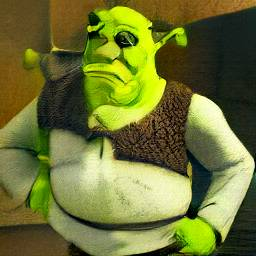
In a way, it makes sense—this genre fusion of modern pop slathered on top of snarky parody-fantasy is kinda the Shrek franchise’s entire thesis. It’s an acknowledgment of these tropes’ enduring influence and importance, but it’s also the cinematic equivalent of Dreamworks pantsing Disney Animation Studios, pushing it over, and snickering as it runs gleefully away. It was this very irreverence that made Shrek fun to begin with. Arguably, it’s the same irreverent spirit that allowed Shrek’s fandom to turn so depraved years later—irreverent rebellion against irreverent rebellion, albeit escalated wildly in the online wilderness.
In light of all that glorious depravity, “Best Years Of Our Lives” seems almost not to fit the rest of my Shrek Songs framework. It doesn’t even really appear in the movie outside the credits. Sonically, it’s pretty much just a bag of hot air—and bizarrely, it makes the rest of Shrek seem deep by comparison. Again, maybe this is good for Baha Men—they avoid the “All Star” curse, and remain relatively unscathed by meme culture’s current vengeful, consuming pillage through the early 2000s (in search of anything it can mock to death). It’s out-of-step with the direction the franchise took after Shrek—and what a wagon to fall off early. Or maybe it’s just good—I don’t know. I’m not even really sure what I was talking about anymore.
So this seems like a good time to discuss the Shrek Broadway musical.
- Swamp to Stage
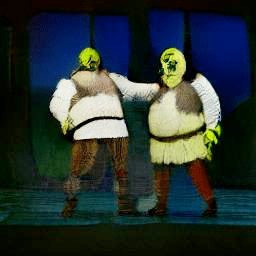
Shrek: The Musical. It’s Tony-Award winning, if you didn’t know. I watched it—OK, part of it. As much as I could stomach. I skipped around, then I just listened to the soundtrack. Look, I’ve done a lot of research for this thing already, and while I’m happy to do it, I gotta draw the line somewhere. I’m choosing to draw the line at having to watch the entire two hours of the Shrek Broadway musical. There are many reasons for that—whether it’s the terrifying costumes, including Shrek’s nightmarish prosthetics, or that throwaway mid-song line about some venereal disease Pinnochio caught in Tijuana (seriously), or just the fact that I’m not generally too crazy about musical theater. There have been exceptions, but this is not one of ‘em. There’s no getting around it—more than anything else, I can’t stand this particular musical because of the music in the musical.
There are almost thirty original songs strewn across its two hours and change. So I’m not kidding when I say that every character who steps foot on that stage, however briefly, gets to sing. Every last goddamn one—from the Dragon to the Three Blind Mice. And even though this thing definitely aims for the rafters routinely, it also sounds remarkably unoriginal, and totally divorced from anything remotely resembling a movie-style Shrek Song. That’s with the narrow exception of the ensemble’s (literal) show-stopping take on “I’m a Believer,” crammed in as the curtain falls for the benefit of anyone wondering, as I did, “When are they gonna sing ‘All Star?’” The musical is pretty much entirely composed of original-for-Broadway, Broadway-style musical theater pastiches—they just all happen to vaguely follow the plot of the film.
There’s also some very strange world building that happens in these songs, and arguably, it builds on the movies in some fun ways—but I gotta be honest: That goal notwithstanding, I just don’t think the ideas are very funny. For example, someone seriously thought it was important that we learn (through heavy implication) that Farquaad is the secret love child of Snow White and Grumpy the Dwarf. And for a guy who spends the vast majority of his first movie shouting down other characters’ singing, Broadway Shrek sings constantly—and every time he does, it sounds exactly as out-of-character as you’d expect. It’s like someone stuffed Roger Bart’s Disney Hercules energy—y’know, in the scene where he’s flying off to Danny DeVito’s goat-man island for training—stuffed it like a dead body into an ogre-shaped potato sack, probably thinking, “Fuck it—these guys’ voices are interchangeable anyway.” Seriously—why is Shrek confessing his powerful, pained longing to be somebody’s hero? Why do I need to be introduced to seven year-old Shrek at all? Who cares?
If I had to pinpoint why this all sucks so bad, I’d say it’s because sapping Shrek of Shrek Songs, and trying to replace them with schlocky high school drama class fantasy fodder is a surefire way to wipe that lovable sneer off the franchise’s face. It rips out Shrek’s soul for the sake of a cash-manufacturing medium-shift. It turns a fairy tale parody into something far less interesting and twice as corny. Whatever your thoughts are on Broadway musical adaptations of movies generally, you cannot convince me that Shrek is Shrek without “All Star.” Something fundamental is missing.
- I Thought Love Was Only True In Fairy Tales
I could go on. I’m already being reductive—I could meander through every cobwebbed room of these soundtracks, from the hackneyed nostalgic power ballad romance of Dana Glover’s “It Is You (I Have Loved)” to the absolutely brilliant-but-perverse inclusion of “Little Drop of Poison.” A few things are clear to me, though. I’ve discussed the “All Star” thesis, the “I’m a schmuck, but I love you” song, and the cartoon throwback dance party jam. And the only way I can think to reconcile these categories, which are so chaotically far-flung, is to say that there is no single, unifying factor, no clean-cut category, no identifiable musical anatomy here.
Rather, Shrek Songs parallel the character’s arc. They represent stages of the journey, not a fixed film identity. And taken in sequence, they appeal to the repressed losers in all of us—like the movies do. These are songs for our inner cynics, who in spite of their worldviews and their best efforts to push everyone away, really just want a little love, acceptance, and tenderness. From the “All Star” loser rock anthems, which depict us at the beginning of our hero’s journey to vulnerability, through the schmuck-songs’ depictions of those life-changing “maybe this ‘love’ thing could actually work for me” moments, and ultimately to the celebratory dance-party resolution, surrounded by all the funny friends we’ve made along the way. Shrek’s journey is our journey. We who society trained to give up on storybooks and their sparkly-clean solutions managed to find some comfort and fulfillment in giving it a try anyway. Shrek Songs ask us to abandon our postmodern disillusionment and indulge in a fairy tale for once—to appreciate a classic “Happily Ever After” even though we know it might not really be “Forever After.” After all, that’s what sequels are for. Instead, we’re taught to cope with the inherent suffering and defeat of existence itself, with a wink to God’s camera and our whole team by our side. We can sulk in our swamps and stay locked in our towers for our entire lives—but it’s a hell of a lot more fun to let the three little pigs breakdance on our lawns.
That all casts the demented, digitally degenerate Shrek renaissance of the 2010s in a much funnier, more sinister light. When we turn Shrek into a sexual deviant in greentext, when we remix “All Star” into the ground, and when we let an arsenal of moronically brilliant online video comedians reshoot the movie scene by scene, we’re not just rejecting the Disney interpretation of fairy tales anymore—the movies themselves already did that for us. Instead, we’re rejecting the Shrek franchise’s own addition, its “cynical but ultimately heartwarming” message entirely. We reject not only the sparkly fairy tale ending that captivated our great-grandparents’ version of America, but also Shrek’s attempt to reinvent that ending for the new millennium.
Twenty-one years later, we’ve grown to hate the early 2000s, with their hollow promise that things still might work out after all, no matter how bad it all may seem. In 2022, we know they won’t. We’ve learned better. There are no princesses to marry, no dreams left to work, and all that glitters sure as shit ain’t gold. So we retreat into “All Star,” having thoroughly convinced ourselves that we never should’ve left the swamp in the first place. This isn’t “Goblin Mode”—it’s Ogre Enlightenment.
In my mind, we’ve arrived at the franchise’s punk phase. Freed from its box office prison, Shrek is now firmly in the hands of the fans. The proletariat has seized the means of production, and they are fucking running for the border with it. DIY Shrek doesn’t care about rescuing damsels or finding peace. He’s become a sort of fantasy Joker, one more contemporary media figure who just wants to burn the whole of our culture to the fucking ground.
And can we blame him? If Shrek was intended to be a reimagining of the hero’s journey, where does the character’s recent paradigm-abandonment leave us? Maybe we’ve rejected the hero’s journey too. Maybe we’ve come to believe that there’s no such thing as heroes, human or ogre. And whether we’d admit it or not, that scares us. No amount of swamp karaoke can console us. We’re no longer believers—there’s too much doubt in our minds. We’re post-Shrek.
So, what’s next for Shrek Songs, now that we’re all pretty much in agreement that we’re thoroughly ogre it? I honestly have no idea. At this point, I’m struggling to remember what the whole point of this soundtrack deep dive was in the first place. Whatever. I find myself in the same position we found Shrek in at the beginning of the whole series: I’m cranky, and I have to take a shit. But I’ll be bringing some William Steig with me—y’know, for “reading material.”
(“Ha! Like that’s ever gonna happen!”)
 SNOT ROCK BOT RADIO
Leave a comment